
About the Artist
I began photographing at night for a simple reason: by day, these towns are crowded with people and signage; by night, they return to what they once were. I have no interest in documenting a monument. What draws me is the moment a street stops being a place you pass through, and becomes something that stops you.
This search for visual authenticity grows out of my own path. Before I sought silence in fine art photography, I spent years documenting the noise of the world as an international photojournalist and press correspondent — working in the field for agencies and networks including APTN, Telemundo NBC, Xinhua, and Ruptly.
That journalistic discipline is what now defines my golden rule in the studio: I work exclusively with existing light and long exposures. No artificial lighting is added, no skies are replaced. What you see in the print was there. My task is to wait — often well past midnight, with a single streetlamp working in my favor — until the scene reveals itself, and only then decide where the frame should end.
Based in Barcelona since 2008, my nocturnal series trace the historic quarters of Girona, Albarracín, Segovia, Pedraza, Peratallada, Beget, and Pals. More recently, I have begun applying this same visual language to open landscapes and urban settings, in a series titled Fragments of City and Landscape.
After years of direct dialogue with collectors at art fairs, in 2024 I opened the doors of my official online gallery to serve collectors and interior designers worldwide. My work is now expanding onto the international circuit, with recent invitations from galleries such as Perseus Gallery to take part in prestigious exhibitions including Chicago Art Fair 2026 and Red Dot Miami 2026.
A photograph doesn't record a place. It records the time I spent waiting for it.
I work in exposures measured in minutes, not fractions of a second. In that interval, the light of a single street lamp accumulates on stone until it reveals texture the eye never catches: the erosion on a lintel, eight centuries of footfall worn into granite. Nothing is added afterwards. What you see in the print was there — my job was to wait for it to appear.
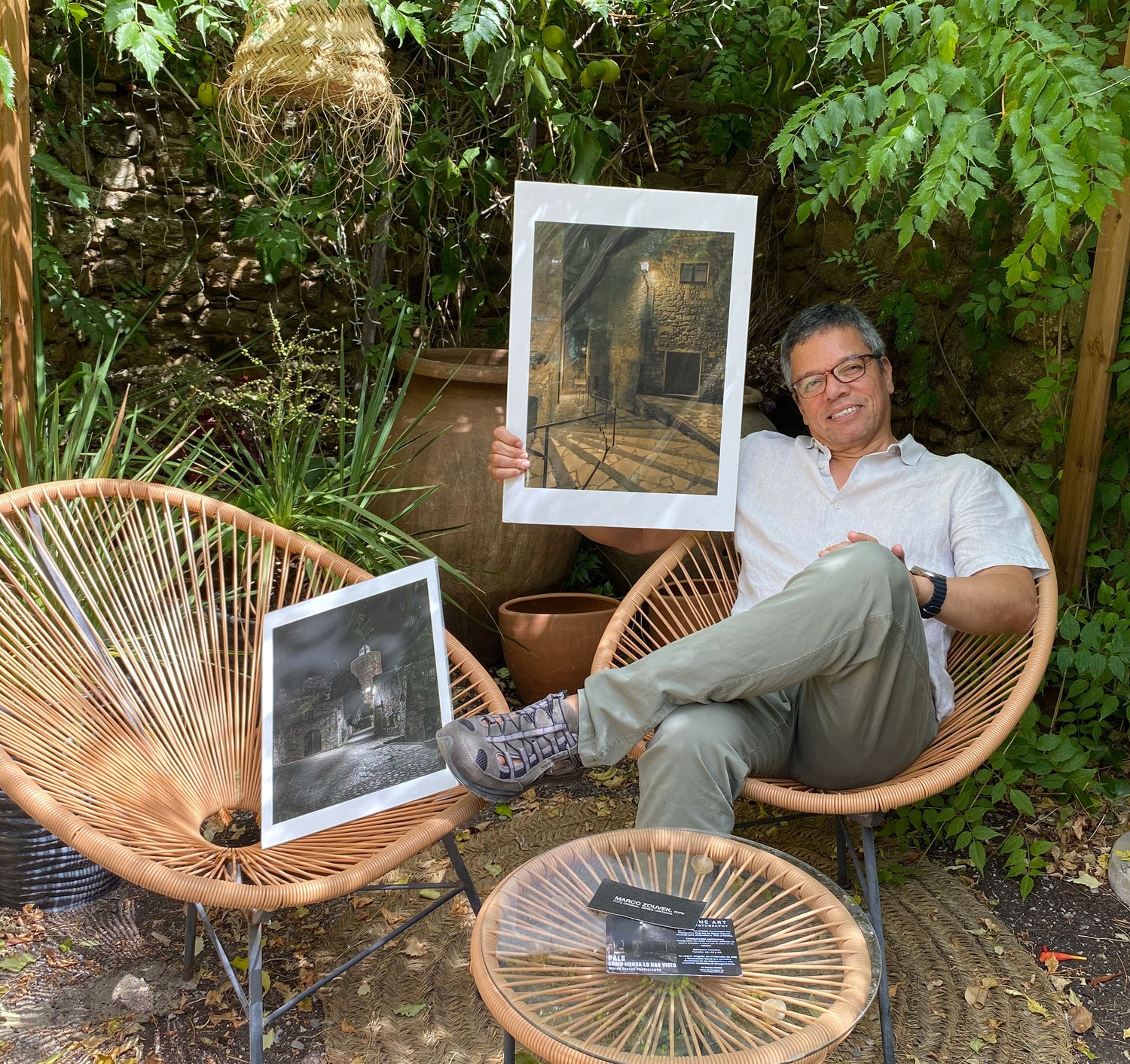
Beauty isn't immediate. It's the art of lasting.
Which is why every print is made to conservation standards. Giclée printing with archival pigment inks rated beyond one hundred years, on Hahnemühle Museum Etching, 350 gsm: one hundred percent cotton, acid-free, with no optical brighteners — the paper the most demanding institutions choose for its tonal depth in the shadows, which in this work is most of the image.
It's respect for the craft that turns an image into an inheritance: the assurance that the atmosphere stopping you today will be intact two generations from now.
Behind the Lens
I'm a photographer and filmmaker, born in Caracas and based in Barcelona since 2008. Before I gave my nights to medieval towns, I spent years covering European news as a correspondent for APTN (UK), Telemundo NBC (US), Xinhua (China) and Ruptly (Germany).
That work — photographing without choosing your light, without a second take, without room for error — is the technical foundation of everything I do now. Night photography demands the same discipline in reverse: here, time is on my side, and I use all of it.
I work regularly across Spain and southern France, and I'll travel anywhere in the world for the right project.

Marco Zouvek Studio
Fine art night photography of Spain's medieval towns. Short, closed editions — three prints per image — signed and numbered, for private collectors and interior design projects.
Most images compete for your attention. These do the opposite: they ask you to stop.
In darkness, in solitude, in complete silence, places change. Ambient light sculpts the forms and the streets say something they never say by day. That's what you take home: not a view of a town, but the feeling of standing alone in it at three in the morning.
Editions are limited to three. When they close, they don't come back.